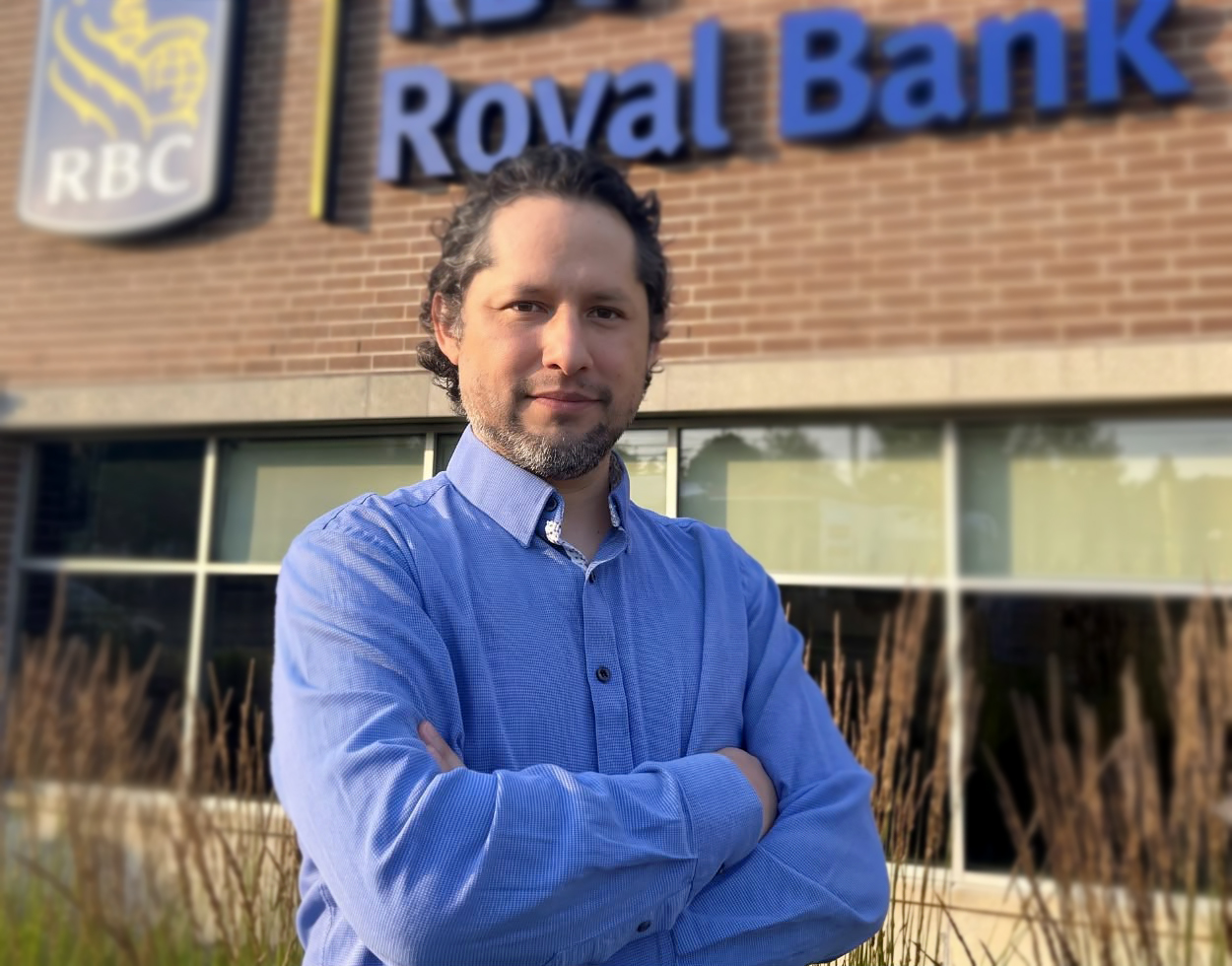

At many organizations, there's a version of architecture work that's mostly coordination — reviewing other people's designs, enforcing standards, sitting in meetings. And then there's this.
In Global Functions Technology’s (GFT) Architecture and Strategy team, the problems that land on an architect’s desk are novel in the sense that the constraints — regulatory, security, operational — are as much a part of the challenge as the technology itself, and millions of people depend on the systems you build.
We asked two architects on the GFT team to describe their work. Here's what they said.
Yuri Orel, Lead Solution Architect, GFT, is modernizing how RBC trains its risk and credit models, roughly 100 statistical and machine learning models that sit at the core of how the bank manages credit risk. The challenge: processing more than 15 years of encrypted financial data while handling massive compute surges during model training, all under strict regulatory requirements.
Yuri’s team helped to make a case for expanding to public cloud: "The key was framing this not as 'legacy vs. modern' but as 'strategic risk reduction.' By showing the total cost of ownership over five years, the resilience gains and the compliance advantages, we shifted the conversation from 'minimize changes' to 'maximize value.'"
The result was a fundamentally better platform — lower training costs, improved fault tolerance and data scientists who can move faster. It's the kind of outcome that's hard to replicate elsewhere: work that directly changes how a global financial institution operates, built on AWS, SageMaker and modern ML tooling.
Francisco Valenzuela, Director, Solution Architecture, GFT is tackling a different but equally layered challenge: a hybrid MLOps platform for retail credit risk decisions. The tension at the centre of it is real. "We need cloud's elasticity and computational power for ML/AI training, but security and operational requirements mandate on-premises serving for credit risk decisions. That's the genuine tension: elasticity versus control, speed versus security, innovation versus risk management."
The solutions, he said, simply aren't in any standard playbook. "We're solving novel problems with the quality standards RBC is known for. That combination — architectural sophistication plus uncompromising quality — creates a different calibre of challenge. It's the kind of work that changes how you think about architecture."
Both architects describe the same shift in perspective that comes with working at this scale. For Francisco, it came from reckoning with the true scope of RBC's global footprint and realizing that the quality standards here are a direct reflection of the weight of what architects build.
In Global Functions Technology’s (GFT) Architecture and Strategy team, the problems that land on an architect’s desk are novel in the sense that the constraints — regulatory, security, operational — are as much a part of the challenge as the technology itself, and millions of people depend on the systems you build.
We asked two architects on the GFT team to describe their work. Here's what they said.
Yuri Orel, Lead Solution Architect, GFT, is modernizing how RBC trains its risk and credit models, roughly 100 statistical and machine learning models that sit at the core of how the bank manages credit risk. The challenge: processing more than 15 years of encrypted financial data while handling massive compute surges during model training, all under strict regulatory requirements.
Yuri’s team helped to make a case for expanding to public cloud: "The key was framing this not as 'legacy vs. modern' but as 'strategic risk reduction.' By showing the total cost of ownership over five years, the resilience gains and the compliance advantages, we shifted the conversation from 'minimize changes' to 'maximize value.'"
The result was a fundamentally better platform — lower training costs, improved fault tolerance and data scientists who can move faster. It's the kind of outcome that's hard to replicate elsewhere: work that directly changes how a global financial institution operates, built on AWS, SageMaker and modern ML tooling.
Francisco Valenzuela, Director, Solution Architecture, GFT is tackling a different but equally layered challenge: a hybrid MLOps platform for retail credit risk decisions. The tension at the centre of it is real. "We need cloud's elasticity and computational power for ML/AI training, but security and operational requirements mandate on-premises serving for credit risk decisions. That's the genuine tension: elasticity versus control, speed versus security, innovation versus risk management."
The solutions, he said, simply aren't in any standard playbook. "We're solving novel problems with the quality standards RBC is known for. That combination — architectural sophistication plus uncompromising quality — creates a different calibre of challenge. It's the kind of work that changes how you think about architecture."
Both architects describe the same shift in perspective that comes with working at this scale. For Francisco, it came from reckoning with the true scope of RBC's global footprint and realizing that the quality standards here are a direct reflection of the weight of what architects build.